

Imagine you wake to a sudden market move in BTC while away from your desktop. You need to log in to your exchange, confirm an open margin position, or move funds to a non-custodial wallet — fast, securely, and with a clear sense of trade-offs. That concrete, time-pressured scenario exposes the three questions traders ask most: how do I authenticate and protect access, what does custody look like on OKX and when should I use the Web3 wallet vs. exchange custody, and how do the mechanics of trading (spot, margin, and derivatives) interact with those custody choices? This article explains those mechanisms, the failure modes to watch for, and a few practical heuristics to help you make decisions under stress.
I assume you’re in the US, familiar with basic crypto concepts, and want clear operational rules rather than marketing lines. Where the platform’s features interact with regulation, security design, or fast markets, I’ll mark limits and conditional implications rather than overclaim. You will get one reusable mental model, a checklist for urgent login safety, and a short set of scenarios that should change what you do next.
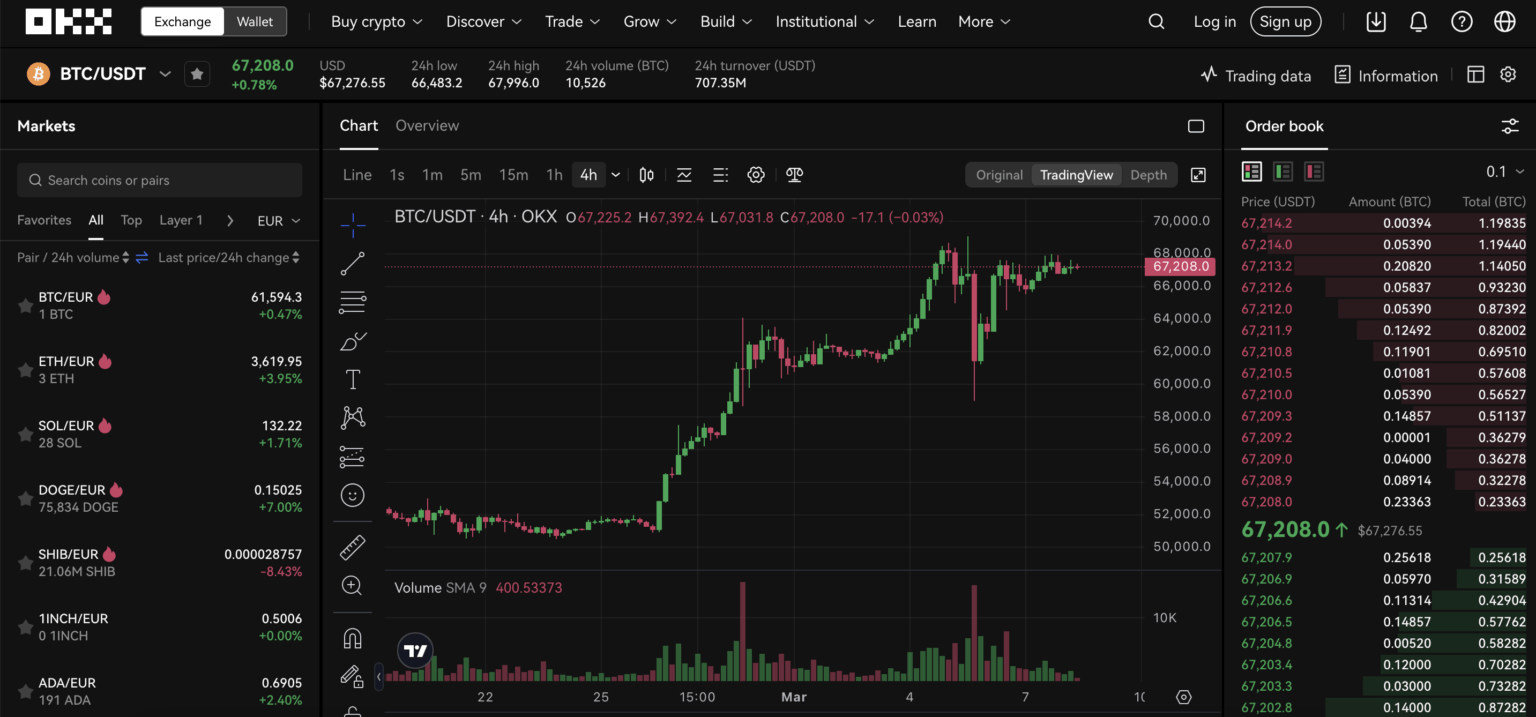
How OKX account login and protection work (mechanics, not slogans)
At the core, logging in to OKX combines three layers: identity verification (KYC), cryptographic account protections, and behavioral detection. Mechanically, account creation in the US requires Know Your Customer (KYC): you submit a government ID and complete a liveness facial check. That anchors the account to a real-world identity for AML compliance; it is not optional if you want fiat onramps or to use most exchange services.
On top of identity, OKX uses mandatory two-factor authentication (2FA). You can choose SMS, an authenticator app (e.g., Google Authenticator), or biometric login on mobile. From a security-design perspective, authenticator apps and biometrics are stronger than SMS because SMS is vulnerable to SIM swap attacks; the difference is mechanistic: possession of your phone number is easier for an attacker to obtain than a Time-based One-Time Password (TOTP) seed stored on your device. The login flow also includes AI-driven real-time threat detection that flags unusual IPs or device fingerprints — this reduces automated account takeovers but can increase friction for legitimate logins from new locations.
Decision heuristic: treat 2FA with an authenticator app (or hardware-backed biometrics on mobile) as the minimum for trading accounts that hold meaningful capital. Keep an emergency contingency (see FAQ) but do not rely on SMS-only security for sizable balances.
Custody options: centralized exchange vs. OKX non-custodial Web3 wallet
There are two distinct custody models inside the OKX ecosystem and they behave differently in practice. The centralized exchange (CEX) custody means OKX holds private keys for assets deposited to your exchange account; these assets are subject to the exchange’s internal controls, withdrawal approval processes, and company-level security practices. Mechanically, OKX keeps over 95% of deposited assets in offline, air-gapped cold wallets secured with multi-signature approvals. That design reduces the probability of large-scale hot-wallet hacks, but it does not eliminate counterparty risk: if the exchange were to freeze withdrawals for regulatory reasons, or suffer internal fraud, access could be restricted despite on-chain proof of reserves.
Contrast that with OKX’s non-custodial Web3 wallet where you control the seed phrase. Mechanically, control shifts from the exchange’s multisig to your private keys: you sign transactions locally, and hardware wallets (Ledger, Trezor) can be attached. The non-custodial wallet removes counterparty custody risk but transfers a set of user-managed risks: losing your seed phrase is irreversible, and interacting with DeFi exposes you to smart contract exploits and phishing sites.
Trade-off framework: think of custody along two axes — counterparty risk and operational burden. Exchange custody reduces operational burden (fewer private-key responsibilities) but increases counterparty and regulatory friction risk. Non-custodial custody reduces counterparty risk and increases operational burden (securely storing seeds, updating firmware on hardware wallets, vetting DApps).
Trading mechanics: spot, margin, derivatives — and how custody affects strategy
OKX supports spot trading across 300+ assets and more than 130 blockchains, margin trading up to 10x, and derivatives including perpetual swaps and options with leverage up to 125x on some products. Mechanically, leveraged positions on the exchange are credit lines within the CEX environment: margin is borrowed from the platform and liquidations are executed by the exchange according to margin ratios. That tight coupling means your ability to enter or exit leveraged trades depends on exchange-side liquidity, maintenance margin mechanics, and how quickly the exchange enforces liquidations during fast moves.
Two practical consequences follow. First, if you plan to use margin or derivatives, those positions must remain on the CEX custody side; you cannot margin-trade from your non-custodial wallet. Second, high leverage amplifies known trading risks—slippage, wide spreads on low-volume assets, and rapid liquidation during volatility. The platform recently delisted several low-volume tokens (this week OKX removed RSS3, MemeFi, GHST, RIO, SWEAT trading pairs), a routine action that can remove thin liquidity pairs or tokens that no longer meet listing criteria. Delisting episodes are a structural reason to avoid concentrated exposure to obscure tokens if you might need to unwind quickly.
Heuristic for position size: for margin and derivatives, cap exposure to a fraction of your portfolio that you could afford to lose in a worst-case flash liquidity event (not just the initial margin). Consider setting stop-loss orders and using isolated margin per position to limit contagion risk across holdings.
On-chain transparency vs. practical access: Proof of Reserves and limits
OKX provides Proof of Reserves (PoR) to allow users to verify that on-chain balances back customer liabilities. Mechanistically, PoR is an on-chain snapshot proof revealing that the exchange holds assets matching customer deposits. This increases transparency but does not eliminate operational risks: PoR shows a balance at a point in time and does not prove continuous solvency under a run, nor does it prevent regulatory holds or internal accounting errors. Treat PoR as a useful signal, not an ironclad guarantee.
From a US user perspective, PoR combined with strong cold-storage practices (95%+ cold with multisig) is a favorable design, but it should be one input among others — governance disclosures, insurance coverage, and your own custody decisions.
Operational checklist for a fast, secure login and trade
When you must act fast:
1) Use the official login flow: bookmark the verified OKX domain or use a trusted bookmark. Phishing is the most common vector for credential theft. 2) Prefer an authenticator app or hardware key over SMS. 3) If logging in from a new device, ensure VPN or IP changes are expected — unusual logins will trigger AI flags that can lock or delay access. 4) If you expect to trade quickly, pre-authorize withdrawal addresses where allowed, but only after rigorous checks (small test transfer). 5) If the move is large and on short notice, consider splitting: transfer the portion you need to trade to the exchange while retaining long-term holdings in non-custodial wallets or hardware wallets.
These are practical rules, born from how mechanisms fail in the wild: phishing, SIM swaps, rapid margin calls, and liquidity evaporation on delisted pairs or thin markets.
What can go wrong — and what to watch next
Known failure modes: account takeover via credential theft, SIM swap, or compromised device; irreversible loss of funds from lost seed phrases or malware; liquidation during flash crashes; and restricted access to funds due to regulatory actions. The delisting of low-volume pairs this week is a reminder that exchange listings are dynamic; exposure to niche tokens can become illiquid or subject to delisting actions that complicate exits.
Signals to monitor in the near term: liquidity on specific trading pairs (order book depth), announcements about delistings or new compliance measures, and any changes to 2FA options or withdrawal processes. For US traders, regulatory developments that affect fiat rails can materially change the practical ability to move funds on and off an exchange.
Decision-useful takeaway and a reusable mental model
Mental model: custody = (control responsibility) + (friction). Exchange custody reduces friction but increases counterparty/regulatory dependence. Non-custodial custody increases personal responsibility but minimizes counterparty dependence. Use the model to choose posture: keep capital you need for frequent trading on the exchange (small working balance), and store the rest in self-custody or hardware wallets. If you must use margin or derivatives, accept that those instruments require staying on the exchange and intentionally limit exposure.
If you want a practical next step, read the official login guidance before you need it; one reliable place to start is the OKX login help page here: okx.
FAQ
Q: Is SMS 2FA safe enough for logging into my OKX account?
A: SMS 2FA is better than nothing but is mechanistically weaker than TOTP authenticator apps or hardware-backed biometrics. SMS can be abused via SIM swaps and number porting attacks. For accounts with meaningful balances, use an authenticator app or hardware security where possible, and keep an offline recovery plan for emergency access.
Q: Can I margin trade from my non-custodial OKX Web3 wallet?
A: No. Margin and derivatives are centralized exchange products and require assets to be held in the CEX custody environment. The non-custodial wallet is for self-custody and direct interaction with DApps and on-chain DeFi; it does not support exchange margin primitives.
Q: What does Proof of Reserves actually prove about OKX?
A: Proof of Reserves shows that the exchange holds on-chain assets corresponding to customer balances at the time of the proof. It improves transparency but does not guarantee continuous solvency, instant withdrawal capability during a run, or immunity from regulatory freezes. Treat it as one data point in assessing counterparty risk.
Q: I lost my seed phrase for the OKX Web3 wallet. Can OKX restore it?
A: No. Non-custodial wallets are designed so only the holder of the seed phrase controls funds. If you lose the seed and have no backup, recovery is effectively impossible. That is the fundamental trade-off of self-custody: more control, more personal responsibility.
Q: How should I prepare for sudden delistings like the one OKX announced recently?
A: Monitor exchange announcements and avoid concentrating capital in low-liquidity, niche tokens. If you hold small-cap tokens that might be delisted, either maintain a plan to withdraw to self-custody early, or accept the increased difficulty of exiting with wider spreads and potentially longer processing windows.
Closing practical note: in everyday operation, the safest posture is deliberate: minimize the balance kept on the exchange to what you need for active strategies, lock the rest into hardened self-custody, and rehearse your emergency steps (how to restore accounts, how to transfer funds under pressure). The mechanisms described here — KYC anchoring, 2FA variants, cold multisig custody, and the structural limits of PoR — define what is possible. Use them as tools, not as guarantees.